

You know that feeling when you’re building a new feature and you just know it’s going to be a hit? It’s a great feeling. But honestly, that gut instinct is a shaky foundation for a product roadmap. There’s a far more reliable, and often overlooked, source of truth sitting right under our noses: customer support interaction data.
Think of your support tickets, chat logs, and feedback forms not as a cost center, but as a continuous, unprompted focus group. Customers are telling you, in their own words, exactly what’s confusing, what’s missing, and what they desperately need. The trick is learning how to listen—systematically.
Why Your Support Team is Your Unsung R&D Department
Sure, surveys and planned user interviews have their place. But support data is raw, unfiltered, and driven by real friction. It’s the difference between asking someone what they might want and observing what they actually struggle with while trying to achieve their job.
Every ticket is a story. A story about a goal, an obstacle, and an emotion—often frustration. When you aggregate these stories, patterns emerge that no single piece of feedback could reveal. You stop guessing about feature requests and start validating them with hard evidence.
The Goldmine You’re (Probably) Not Mining
So, what exactly are we looking for? It’s more than just a list of “bugs” and “enhancements.” Here’s the deal:
- Pain Point Frequency: Is the same basic workflow question popping up 50 times a week? That’s not a user error problem; it’s a UX problem.
- Feature Request Synonyms: Customers rarely use your internal jargon. They might describe a “dashboard widget” as “a place to see my numbers at a glance.” Tagging these synonyms is crucial.
- The Workaround Narrative: Pay close attention when users describe their clumsy solutions. “I export the data to Excel to do X, then re-upload it.” That’s a glaring gap in your product.
- Emotional Language: Words like “frustrated,” “time-consuming,” or “impossible” are huge red flags signaling a critical pain point that needs addressing.
A Practical Framework: From Ticket to Trello Card (or Jira, or Asana)
Okay, so you’re convinced. But how do you move from a chaotic inbox to actionable insights? You need a process. Let’s break it down.
Step 1: Tag, Categorize, and Quantify
First, you have to get organized. Implement a consistent tagging system in your helpdesk software (like Zendesk, Intercom, or Freshdesk). Tags should go beyond “bug” or “question.” Create tags for:
- Specific product areas (e.g., #billing-module, #reporting-tool)
- Types of friction (e.g., #onboarding-stuck, #ui-confusing)
- Potential severity (e.g., #blocks-workflow, #minor-annoyance)
This turns qualitative stories into quantitative data. You can now say, “Requests related to the reporting export function have increased 120% this quarter.” That’s a powerful statement.
Step 2: Bridge the Gap Between Support and Product
This is where most companies fail. Support and product teams need a regular, structured handshake. Establish a recurring meeting—bi-weekly is a good start—dedicated solely to reviewing support-driven insights. Call it the “Voice of the Customer Sync.”
In this meeting, support leads present the top pain points and aggregated customer feedback for product development. Product managers bring their roadmap context. Together, they prioritize. This meeting transforms support from a reactive force to a strategic partner.
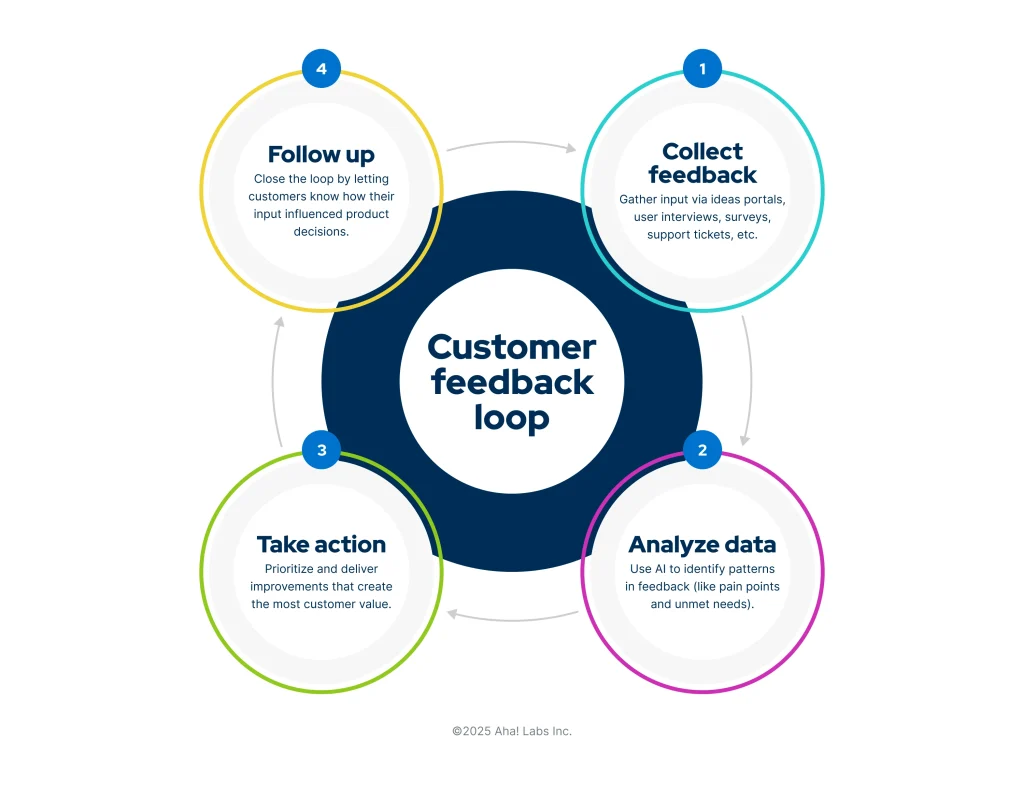
Step 3: Close the Loop (This is Non-Negotiable)
Nothing kills internal morale and external trust faster than the “black hole” effect. When a customer’s great idea vanishes into the void, they stop giving feedback.
Build a simple system to notify customers when their feedback leads to change. A quick, personalized email from a support agent or a public changelog note that says, “Based on your feedback, we’ve added…” is pure gold. It builds incredible loyalty and encourages more valuable input.
Seeing the Patterns: A Simple Insight Table
Here’s a hypothetical look at how raw support data translates into a product decision. This is the kind of clarity you gain.
| Common Support Ticket Theme | Customer’s Wording (The “Voice of Customer”) | Underlying Need / Product Insight | Potential Action |
| Slow report generation | “I click ‘run report’ and go get coffee. It takes forever.” “Can I schedule these to run at night?” | Users are blocked on time-sensitive tasks. They need asynchronous, scheduled reporting. | Prioritize background report scheduling and notifications. |
| Confusing permission settings | “My teammate says they can’t see the project. I added them, I think?” “Where do I control who edits vs. who views?” | Permission UI is not intuitive. Role-based permissions are misunderstood. | Redesign permissions UX and add a “share” wizard. |
| Mobile app limitation | “I can approve invoices on your site but not in the app. I’m always on the go.” “Why is feature X only on desktop?” | Mobile is not a companion, but a primary interface for key user personas. | Re-evaluate mobile roadmap parity for core workflow features. |
Avoiding the Pitfalls: It’s Not Just a Numbers Game
Loudest voice doesn’t always equal best idea. A single enterprise client might submit 10 tickets about a niche need, while 100 small users silently struggle with a fundamental flaw. You have to weigh frequency against impact.
Also, beware of the “squeaky wheel” bias. The customers who contact support are a segment of your whole user base. You must balance their input with data from usage analytics (like feature adoption rates) and silent churn signals. It’s a triangulation exercise.
And one more thing—don’t just build every feature requested. Sometimes, the right response to a flood of support tickets is to simplify or better educate, not to add more complexity. The best product teams use support data to ask, “How can we make this so intuitive that the tickets stop?” instead of just, “What feature will make them happy?”
The Ultimate Competitive Edge
In the end, leveraging customer support interaction data is about building a product that fits like a glove. It’s a continuous conversation, a feedback loop that never sleeps. When you institutionalize this listening, something shifts.
Your product roadmap becomes less about shiny objects and more about removing obstacles. Your support team feels empowered, knowing they’re shaping the product. And your customers? They feel heard, even before their specific request is built. They sense a product that evolves with them, that smooths out its own rough edges.
That feeling—the feeling of a product that just gets its users—doesn’t come from a visionary guess. It comes from a thousand small, honest conversations hidden in your support queue. The blueprint for your next big thing is already there, waiting in the data. All you have to do is start reading between the lines.



More Stories
Building Your Tribe: The Art of Community-Led Support for Niche SaaS
Building Your Dream Team: How to Establish a Hybrid Human-AI Agent for 24/7 Global Support
Building a Proactive Support Strategy Using Predictive Analytics and Customer Data