


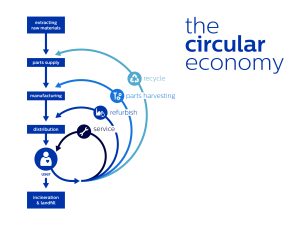
Think about the last time you threw something away. A broken gadget, an old piece of furniture. In our linear “take-make-dispose” world, that’s the end of the story. But what if we designed products—and workplaces—to eliminate the very concept of waste? That’s the promise of the circular economy.
Now, here’s the uncomfortable parallel. For decades, talent management has been strikingly linear. We acquire (hire), we use (employ), and we dispose (offboard). It’s a costly, inefficient, and frankly, a bit of a soul-crushing cycle. Employees become consumable resources. Their departure is a loss, an expense, a problem to be solved.
But what if we could close the loop? Let’s dive into how applying circular economy principles to the employee lifecycle isn’t just a nice idea—it’s a strategic imperative for building resilient, agile, and genuinely human organizations.
The Core Idea: Redefining “Waste” in the Talent Lifecycle
In a circular model, waste is a design flaw. So, in talent terms, what constitutes “waste”? It’s not just the cost of a vacant seat. It’s the institutional knowledge walking out the door. It’s the untapped potential of an employee stuck in a role that doesn’t fit. It’s the skills that become obsolete because we didn’t invest in renewing them. Honestly, it’s the sheer energy spent constantly recruiting for the same roles while former stars work for our competitors.
The goal shifts from mere retention to regeneration and reuse. We aim to keep talent, skills, and knowledge in continuous flow within the organizational ecosystem. It’s about designing a talent system that is restorative by intention.
Mapping the Circular Employee Lifecycle
1. Design & Hire with Longevity in Mind
Circularity starts at the very beginning. Instead of hiring for a narrow, rigid job description, think about hiring for adaptable potential and core values. It’s like designing a modular product. You want components (skills, attitudes) that can be reconfigured as needs change.
This means:
- Skills-over-roles: Focusing on transferable competencies (problem-solving, collaboration, learning agility) that have a longer shelf-life than specific technical know-how.
- Cultural add, not just fit: Seeking diverse perspectives that challenge and renew the organizational culture, preventing intellectual stagnation.
- Transparent pathways: Being upfront during recruitment about potential career journeys and lateral moves within the company. It sets the expectation of growth and change from day one.
2. Use & Maintain: The Phase of Continuous Renewal
This is the longest phase, and where the magic of circular talent management really happens. The goal is to maximize utility and prevent premature obsolescence. You know, like maintaining and upgrading a well-made product.
Key strategies here include:
| Circular Principle | Talent Management Application |
| Maintenance & Repair | Proactive well-being programs, mental health support, conflict mediation. Fixing the work environment before burnout “breaks” the employee. |
| Refurbishment & Upgrading | Continuous, embedded learning. Micro-credentials, internal gigs, stretch assignments. Reskilling employees for adjacent roles before their skills decay. |
| Sharing & Maximizing Utilization | Internal talent marketplaces. Where employees can “loan” their skills to other projects or departments, preventing skill silos and underutilization. |
3. Reuse, Redistribute & Remanufacture: The “Offboarding” Myth
This is where the linear model falls apart. An employee resigns. The linear response? A rushed exit interview, a farewell card, and a scramble to backfill. The circular response? A thoughtful transition that sees this not as an end, but a potential pivot in an ongoing relationship.
Alumni networks are the classic example, but we can go deeper. Consider:
- Boomerang hires: Actively welcoming back former employees. They return with new external experience and re-acculturate quickly—a huge win.
- Knowledge recycling: Structured handover processes that capture critical tacit knowledge, not just task lists. Using departing employees as mentors or trainers during their notice period.
- Ecosystem partnerships: When an employee leaves for a client, partner, or even a non-competing startup, reframing it as strengthening a strategic network. It’s redistribution, not loss.
The Tangible Benefits: Why Bother?
Sure, this sounds nice in theory. But in practice? The benefits are stark. Companies embracing circular talent principles see drastic reductions in hiring costs—because they’re filling more roles internally. They protect their institutional memory. Their employer brand transforms; they’re seen as a place that develops people, not just uses them up. And in an era of constant disruption, they build a workforce that is inherently more adaptable and resilient.
It also, frankly, addresses a deep modern pain point: the craving for growth and purpose. People don’t want to be disposable parts. A circular approach signals that you value their whole journey, not just their output this quarter.
Getting Started: It’s a Mindset Shift
You don’t need a massive HR overhaul tomorrow. Start with a mindset audit. Begin asking:
- When we discuss turnover, do we only talk about cost, or also about the loss of knowledge and network?
- Do our learning programs feel like occasional repairs, or like an operating system constantly updating?
- Do we celebrate and track internal mobility with the same gusto as external hiring?
- When someone leaves, is our final action to deactivate their badge, or to invite them into an alumni community?
The circular economy in the physical world is about designing systems that work in harmony with natural cycles. The circular talent economy is no different. It’s about designing a people system that works in harmony with human nature—our need to grow, to contribute, to connect, and to find meaning.
It turns the talent lifecycle from a straight line with an exit into a series of loops, curves, and possible returns. The end result? An organization that doesn’t just consume talent, but cultivates it, continuously. And that might just be the most sustainable competitive advantage there is.

More Stories
Managing Cross-Generational Conflict in Legacy Industries
Psychological safety in remote onboarding programs: Why it matters and how to build it
Resilience and Crisis Leadership: Steering Through the Storm